Plant library · Green belt · Avenue & campus · Miyawaki forest
Amaltas
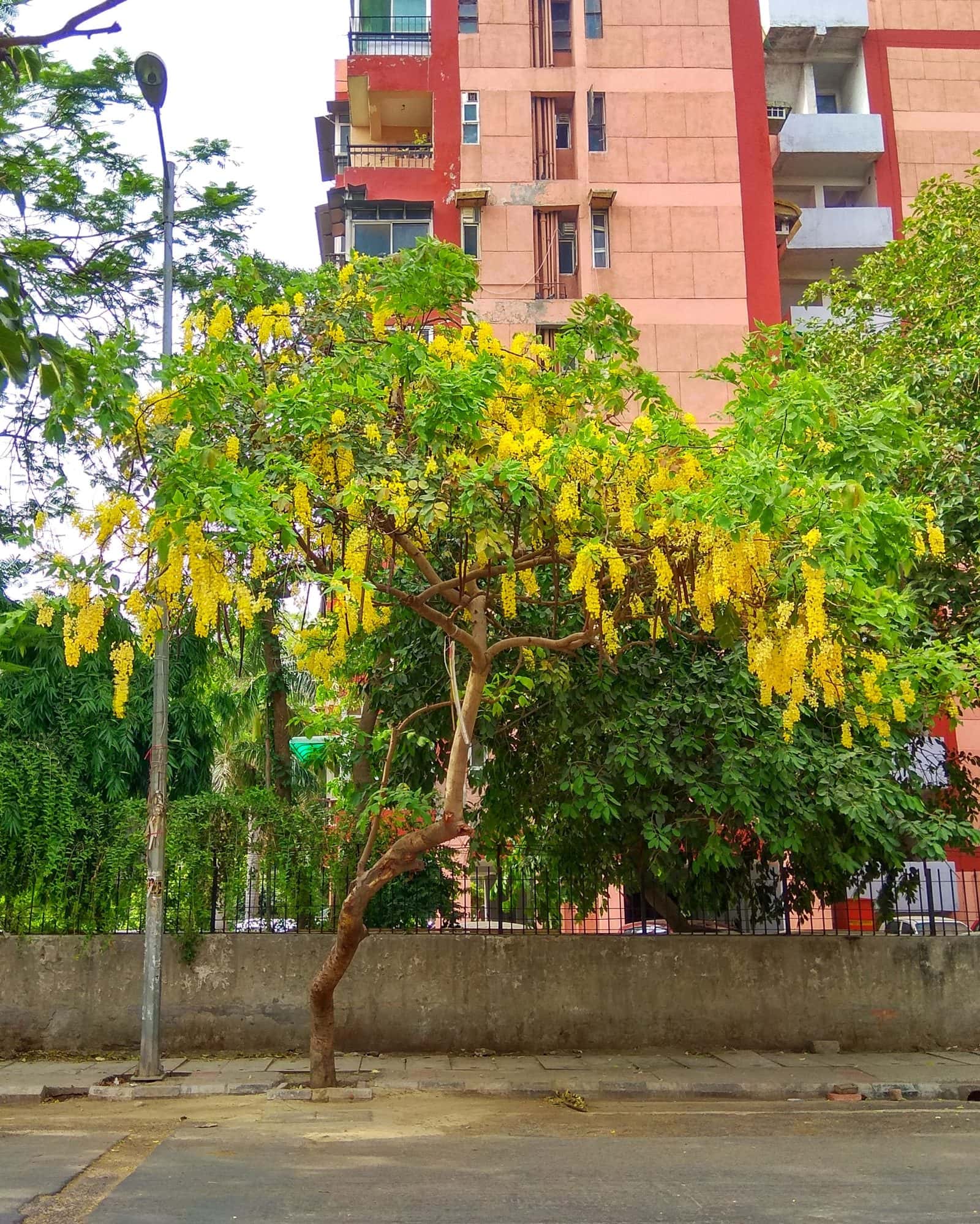
Amaltas is a native Indian tree known for its long hanging bunches of yellow flowers in April and May. It is hardy, takes heat and drought well, and grows in almost every part of the country. It is the state flower of Kerala, where the blossom is part of the Vishu festival.
Cassia fistula · Amaltas · Bahava · Sonalu · Kanikonna · Konrai · Rela · Garmalo · Kakke · Golden shower · Indian laburnum
Size
8–12 m tall, 6–9 m spread
Growth
Moderate
Leaf
Deciduous
Sun
Full sun.
Water
Water young plants weekly in the dry season for two years; after that it lives on rainfall in most of India.
Soil
Most soils, including poor, stony and alkaline ground, as long as water drains away.
01
How to recognise Amaltas
Family Fabaceae
- aLeaves are pinnate, 30–40 cm long, with 4–8 pairs of large, oval, bright green leaflets.
- bFlowers are bright yellow, in long hanging chains 30–50 cm long, from April to June, often when the tree has shed most of its leaves.
- cFruit is a long, round, stick-like pod, 30–60 cm, green at first and turning dark brown to black; it rattles when dry and has a sticky dark pulp inside.
- dBark is smooth and pale grey on young trees, becoming rough and darker brown with age.
- eOften confused with Copper Pod (Peltophorum), which also has yellow flowers, but in upright clusters above feathery leaves, with short flat pods.
02
Amaltas in your city
How it grows in each city we work in, and what we do differently there.
It grows well on Pune's murum and red soils and flowers well after the dry season. We plant in June and water only through the first two summers.
Amaltas handles Delhi's 45°C summers and light winter frost, and it is common on Delhi roads. Young saplings get a mulch ring and weekly water from March to June.
It suits Indore's hot summers and grows on stony ground. On black cotton soil we add murum and sand to the pit so the roots do not sit in wet clay during the monsoon.
It tolerates Chandigarh's winter cold once past the sapling stage and flowers well in May. We plant after the monsoon and protect first-year plants from frost.
It grows well in Mumbai if the site drains; waterlogged ground slows it badly. We plant on raised beds in low-lying plots and away from the sea front where salt spray is heavy.
Bangalore's mild climate suits it and flowering is dependable. We use it along internal roads and boundaries where its light canopy lets lawns grow underneath.
It is well suited to the hot, dry Deccan and to Hyderabad's red soils. Once established it needs almost no irrigation.
Amaltas is one of the more reliable flowering trees for Ahmedabad's 45°C heat and dry winters. We water saplings deeply once a week through the first two summers.
Sonalu grows well in Kolkata's warmth and flowers before the monsoon. We raise planting beds where the ground floods, since standing water causes root rot.
03
Amaltas for industrial green belts
Where it goes in a three-row belt
Boundary side ← → factory side. This plant: middle row.
Amaltas is commonly used in green-belt plans in India because it is native, hardy and survives on poor ground with very little water once established. It grows on stony, alkaline and murum soils where many ornamental trees fail, and it tolerates dust and summer heat. Its crown is lighter than trees like Neem or Mahogany, so it works best mixed with denser evergreen species.
We place it in the middle row, between the tall boundary row and the low inner row, spaced so that its crown fills the gap below the taller trees. Its yellow flowers in summer also make the belt look planned from inside the site.
The species mix, row width and planting density that apply to your unit are the ones written into its own consent to establish or environmental clearance. Clearances commonly ask for about 2,500 trees per hectare, and we plan the rows to meet the numbers in your document.
04
Where it fits
- The middle row of an industrial green belt, where it adds a native flowering species to the mix.
- Avenues and internal roads in campuses and housing societies.
- Farmhouse boundaries and driveways that need a hardy, low-water tree.
- Miyawaki plantings as a native sub-canopy species.
05
Care
- Plant during the monsoon and water weekly through the first two dry seasons.
- Stake young trees in windy sites until the trunk is firm.
- Prune lightly after flowering to shape the crown and remove crossing or low branches.
- Remove old pods from trees near paths and seating if the dry pods and fallen pulp are a nuisance.
- Avoid heavy fertiliser; a basket of compost at planting and once a year for the first few years is enough.
06
Common problems
- Leaf-eating caterpillars — leaves are stripped in the monsoon, often by larvae of the yellow emigrant butterflies. Established trees recover; on young plants we hand-pick or use a Bt spray.
- Pod borers — holes in pods and pulp. It does not harm the tree; remove and destroy affected pods if you want clean pods.
- Root rot — leaves yellow and branches die back on waterlogged ground. Improve drainage or replant on raised soil.
- Powdery mildew — white coating on young leaves in humid spells. Usually minor; improve air movement and spray sulphur only if it spreads on young trees.
07
Questions
When does Amaltas flower?
Mostly from April to June, with the peak in May in north and central India. In Kerala it is timed with the Vishu festival in mid-April.
How long does Amaltas take to flower from a sapling?
A healthy nursery sapling usually flowers in 4–6 years. Trees raised from seed can take longer.
Is Amaltas good for an industrial green belt?
Yes. It is native, drought tolerant and grows on poor soil, and it is commonly used in green-belt plans. It works best in the middle row, mixed with denser evergreen trees.
Does Amaltas need a lot of water?
No. Water it weekly through its first two dry seasons. After that it survives on rainfall in most Indian cities.
Also used for green belt
Guides that mention Amaltas
Begin with a visit
Request a proposal
Tell us about the space, or send photos on WhatsApp. We send a written proposal with a fixed price.
hi@gardenandacre.com