Plant library · Green belt · Avenue & campus · Miyawaki forest
Jamun
Jamun is a native evergreen tree with glossy leaves, a dense crown and purple-black fruit in early summer. It gives deep shade all year, grows in a wide range of soils and puts up with some waterlogging. It is a staple of avenues, green belts and farm boundaries across India.
Syzygium cumini · Jambul · Jambhul · Jambu · Naaval · Neredu · Nerale · Kalo Jam
Size
12–20 m tall, 8–12 m spread
Growth
Moderate
Leaf
Evergreen
Sun
Full sun to light shade
Water
Moderate; tolerates short spells of waterlogging
Soil
Most soils, from sandy loam to clay; does best on deep, moist soil
01
How to recognise Jamun
Family Myrtaceae
- aLeaves are opposite, glossy, leathery and elliptic, 7–15 cm long, with a faint turpentine-like smell when crushed.
- bFlowers are small, creamy white and fluffy with many stamens, usually from about March to April.
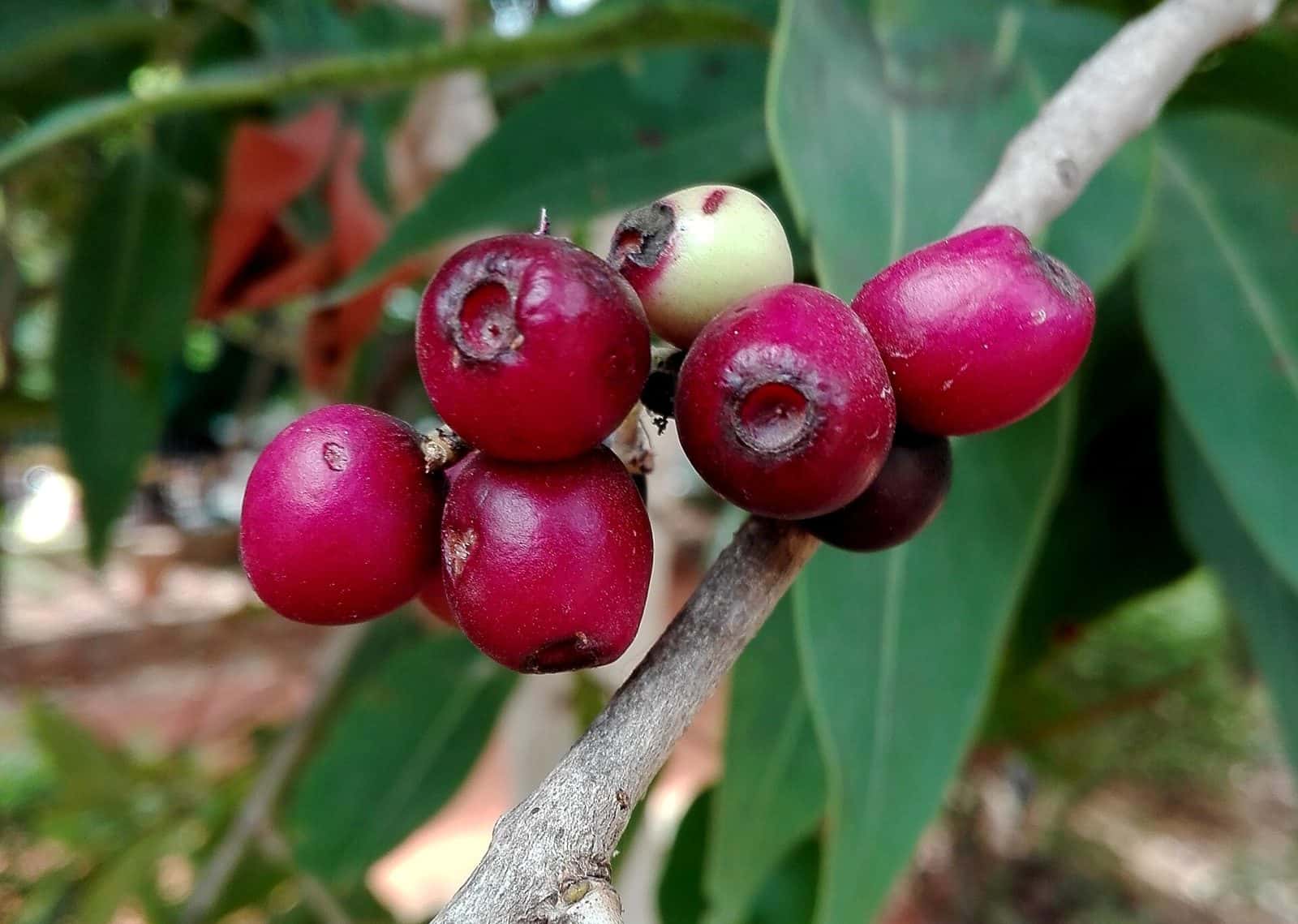
- cFruit is an oval berry, green, then pink, then deep purple-black, ripening around June–July and staining hands and paving.
- dBark is grey-brown, smooth on young trees and becoming rough and flaky with age.
- eOften confused with other Syzygium trees, such as the water apple, which have larger, paler, bell-shaped fruit.
02
Jamun in your city
How it grows in each city we work in, and what we do differently there.
Jamun grows well in Pune and fruits reliably. On shallow soils we dig deeper pits and water through the first two summers.
Jamun is a common avenue tree in Delhi. Young trees need cover from frost in January and regular water through May–June heat.
Jamun suits Indore's deeper black soils. On stony ground we add soil and compost to the pit and water through the first summers.
Jamun grows in Chandigarh, but saplings can be frost-damaged in December–January. We plant in the monsoon and protect young trees for two winters.
Jamun handles Mumbai's heavy monsoon and humid air well. We keep it away from parking and paved paths because of fruit drop.
Bangalore's mild climate suits jamun, and it is common along older roads in the city.
Jamun grows in the hot, dry Deccan with regular watering in the first three summers. Mulching helps hold moisture.
Ahmedabad's 45°C summers and dry winds stress young jamun. We water weekly through April–June and plant where the soil is deeper.
Jamun does well in Kolkata's humid climate and alluvial soils, and tolerates brief waterlogging in the monsoon.
03
Jamun for industrial green belts
Where it goes in a three-row belt
Boundary side ← → factory side. This plant: middle row.
Jamun is native and evergreen, with a dense crown of glossy leaves that holds dust through the year. It tolerates wet ground better than many dry-zone trees, and its fruit feeds birds in early summer. It is commonly used in green-belt plans across India.
We usually place jamun in the middle row, between the tallest boundary trees and the lower inner planting, where its dense crown closes the gaps. On wide belts it can also sit in the outer row. We keep it away from the edge of internal roads and parking, where falling fruit becomes a nuisance.
The species mix, belt width and planting density that apply are the ones written into the unit's own consent to establish or environmental clearance. Clearances commonly ask for about 2,500 trees per hectare, and we plan the rows to match whatever the document says.
04
Where it fits
- Middle row of a green belt, where its dense evergreen crown fills gaps.
- Avenue tree along internal roads, set back from footpaths.
- Boundary and fruit tree on farmhouses and farms.
- Canopy species in a Miyawaki forest.
05
Care
- Water weekly in dry months for the first two to three years.
- Mulch the basin to keep the roots cool in summer.
- Shape young trees to a single trunk for avenues and belts.
- Clear fallen fruit from paths in June–July.
- Apply compost once a year before the monsoon on farm trees grown for fruit.
06
Common problems
- Leaf-eating caterpillars — chewed and webbed leaves on new growth. Remove webbed shoots by hand on young trees and spray only if damage is heavy.
- Fruit fly — maggots in ripening fruit and early fruit drop. Collect and destroy fallen fruit; use traps on farm trees grown for fruit.
- Anthracnose — dark spots on leaves and fruit in wet weather. Remove affected fruit and improve airflow in the crown.
- Frost damage — browned leaves on young trees after cold nights in north India. Protect saplings and prune dead tips in spring.
07
Questions
How many years does a jamun tree take to fruit?
Seedling trees usually start fruiting after about eight years. Grafted plants begin earlier, often in four to five years.
How far from a house should a jamun tree be planted?
Keep jamun about 5–6 m from buildings, and away from parking and paved areas where fallen fruit stains.
When is the best time to plant jamun?
Plant in the monsoon, June to August. In north India, earlier monsoon planting gives the tree time to settle before winter frost.
Is jamun a good tree for a green belt?
Yes. Jamun is evergreen, native and dense, and it is commonly used in green-belt plans, usually in the middle row.
Also used for green belt
Begin with a visit
Request a proposal
Tell us about the space, or send photos on WhatsApp. We send a written proposal with a fixed price.
hi@gardenandacre.com