Plant library · Avenue & campus · Green belt · Miyawaki forest
Kachnar
Kachnar is a small to medium native tree known for its two-lobed leaves and pink, purple or white flowers that open on nearly bare branches in late winter and spring. It is hardy, tolerates dry spells and light frost once established, and stays a manageable size, which makes it a common choice for roadside avenues, campus drives and the middle rows of green belts. In a Miyawaki forest it sits in the tree layer, below the canopy species.
Bauhinia variegata · Kachnar · Kanchnar · Kanchan (Marathi, Bengali) · Kovidara (Sanskrit) · Orchid tree · Mountain ebony
Size
6–10 m tall, 5–8 m spread
Growth
Moderate
Leaf
Deciduous
Sun
Full sun; flowers poorly in shade
Water
Regular watering for the first two summers, then occasional deep watering in dry months
Soil
Most well-drained soils, including loam, sandy loam and gravelly soils; dislikes standing water
01
How to recognise Kachnar
Family Fabaceae
- aLeaves are broad and split at the tip into two rounded lobes, often described as a camel's hoof or butterfly shape.
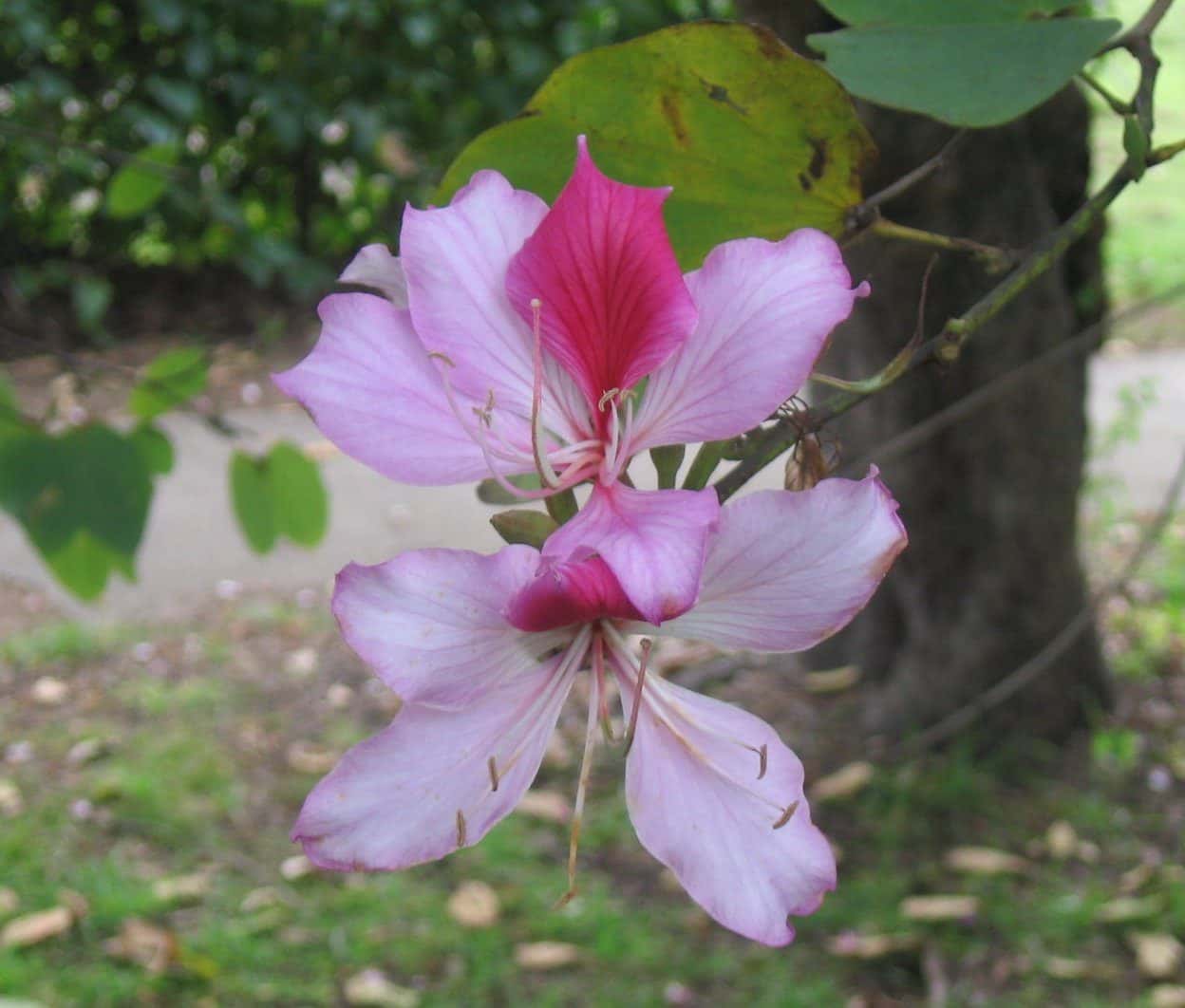
- bFlowers are large, five-petalled and orchid-like, pink to mauve with a darker streaked petal; the white form is sold as variety candida.
- cFlowering is from about February to April, usually when the tree has shed most of its leaves.
- dPods are long, flat and woody, turning brown and hanging on the tree for months.
- eBark is grey-brown and fairly smooth on young trees, becoming rougher with age.
- fOften confused with Bauhinia purpurea, which flowers in October–November with narrower petals, and with the Hong Kong orchid tree (Bauhinia × blakeana), which flowers in winter and rarely sets pods.
02
Kachnar in your city
How it grows in each city we work in, and what we do differently there.
Mild winters and a moderate monsoon suit it well. Flowering is reliable on open, sunny sites across Pune.
Widely planted in Delhi and tolerant of the December–January cold once established. Young plants need regular watering through the 45°C May–June heat.
Handles the Malwa climate well. On black cotton soil we open a wider pit and add murrum or sand so the roots are not sitting in sticky, waterlogged clay.
Its natural range includes the Himalayan foothills, so it copes with frost better than most flowering trees. Very young saplings benefit from a cover on the coldest nights in their first winter.
Grows, though flowering is lighter in the humid coastal climate than inland. Plant on raised, well-drained spots away from direct sea spray.
The mild climate suits it and it is seen along many Bangalore roads. Needs full sun to flower well.
Tolerates the hot, dry Deccan summer once established. Deep watering every week or two through April–May for the first two years.
Survives the 45°C summers but needs regular irrigation for the first two to three years. Mulch the base to keep the root zone cool.
Grows, but heavy monsoon rain and poorly drained ground can cause root problems. Plant on mounds or raised beds where water collects.
03
Kachnar for industrial green belts
Where it goes in a three-row belt
Boundary side ← → factory side. This plant: middle row.
Kachnar is a native, hardy tree that tolerates dry spells and a range of soils, and it is commonly used in green-belt plans for the flowering interest it adds between taller trees. Its moderate size means it does not compete strongly with the outer tall row, and its broad leaves help trap dust.
We place it in the middle row, behind tall trees such as neem or semal and in front of the inner shrub row, spaced so crowns can close over a few years. It is deciduous for a few weeks in late winter, so we mix it with evergreen species in the same row to keep year-round cover.
The species mix, belt width and planting density that apply to a site are the ones set out in the unit's own consent to establish, consent to operate or environmental clearance.
04
Where it fits
- Avenue plantings along internal roads, where its moderate height stays clear of overhead lines.
- Middle row of an industrial green belt, between tall canopy trees and inner shrubs.
- Tree layer of a Miyawaki forest, under taller canopy species.
- Campus drives, parking edges and farmhouse entrances where spring flowering is wanted.
05
Care
- Water weekly in the first summer and fortnightly in the second; established trees need only occasional deep watering in long dry spells.
- Prune lightly just after flowering to shape the crown and remove crossing branches; heavy pruning later in the year removes next season's flowering wood.
- Stake young avenue trees for the first year so wind does not tilt them.
- Apply compost or well-rotted manure around the drip line before the monsoon.
- Remove low side branches gradually on avenue trees to give clearance for vehicles and people.
06
Common problems
- Leaf-eating caterpillars — irregular holes and skeletonised leaves in the monsoon; hand-pick on small trees or use a biological spray such as Bt if damage is heavy.
- Stem and bark borers — sawdust-like frass and holes on the trunk; clean the tunnel and treat it, and keep trees healthy with regular watering.
- Root rot on waterlogged sites — yellowing, wilting and dieback after heavy rain; improve drainage or replant on a raised mound.
- Poor flowering — usually too much shade or late pruning; move future plantings to open sun and prune only after flowering.
07
Questions
When does kachnar flower?
Bauhinia variegata usually flowers from February to April, often on nearly leafless branches. A tree that flowers in October–November is more likely Bauhinia purpurea.
How fast does kachnar grow?
At a moderate rate. A well-watered sapling usually starts flowering within three to four years of planting, depending on its size at planting and the site.
Can kachnar be planted near a house wall?
Keep it at least 3–4 m from walls and foundations so the crown and roots have room. It is not an aggressive-rooted tree, but a tree of this size still needs space.
Are kachnar buds edible?
The flower buds are cooked as a vegetable in parts of north India. If you plan to harvest them, avoid spraying chemical pesticides on the tree.
Also used for avenue & campus
Guides that mention Kachnar
Begin with a visit
Request a proposal
Tell us about the space, or send photos on WhatsApp. We send a written proposal with a fixed price.
hi@gardenandacre.com