Plant library · Green belt · Miyawaki forest · Avenue & campus
Kadamb
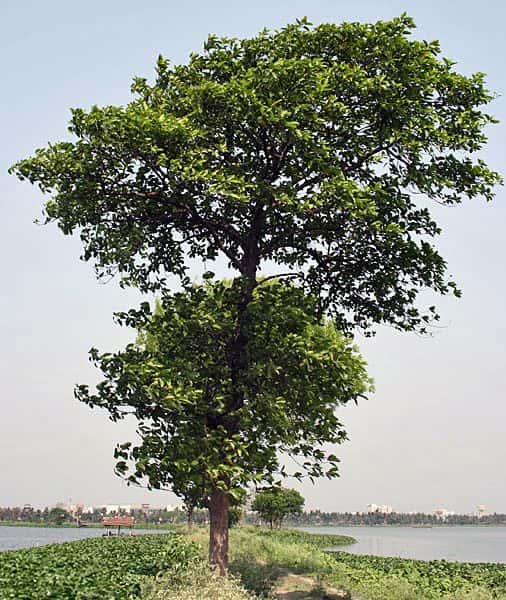
Kadamb is a fast-growing native tree with a straight trunk, tiered branches and round, orange-yellow flower heads in the monsoon. It fills space quickly, which makes it useful where a canopy is needed early. It is associated with Krishna in Indian tradition and is often planted near temples and water.
Neolamarckia cadamba · Kadam · Kadamba · Kadambamu · Vellai Kadambu
Size
15–25 m tall, 8–12 m spread
Growth
Fast
Leaf
Semi-evergreen
Sun
Full sun
Water
Moderate to high; likes moist soil and tolerates brief waterlogging
Soil
Deep, moist alluvial and loamy soils; struggles on shallow, dry, stony ground
01
How to recognise Kadamb
Family Rubiaceae
- aLeaves are large, glossy and opposite, 15–25 cm long, with clearly marked veins.
- bFlowers are small and tubular, packed into round, golf-ball-sized heads that are orange-yellow and fragrant, usually from June to August.
- cFruit is a fleshy yellowish-green ball, formed from the flower head after the monsoon.
- dBranches grow out almost horizontally in tiers from a tall, straight trunk, giving young trees an umbrella shape.
- eBark is grey and smooth on young trees, becoming rough and fissured with age.
02
Kadamb in your city
How it grows in each city we work in, and what we do differently there.
Kadamb grows fast in Pune where soil is deep and moist. On shallow murrum we give it large pits and regular water in the first dry seasons.
Kadamb grows in Delhi, but young trees are frost-tender in January and stressed by dry May heat. We plant in July and water well through the first two summers.
Kadamb grows on Indore's deeper black soils but struggles on stony patches. We choose deeper spots and water through the dry season for the first three years.
Chandigarh's winter frost can damage young kadamb badly. We plant it in sheltered spots and protect saplings for at least two winters.
Kadamb grows very fast in Mumbai's heavy monsoon. We keep it back from buildings because its branches can snap in strong monsoon winds.
Bangalore's mild, moderately wet climate suits kadamb. It establishes quickly on campuses and around lakes.
The hot, dry Deccan summer is hard on young kadamb. We plant it near water or where irrigation is reliable.
Ahmedabad's 45°C heat and dry soil stress kadamb. We give it deep watering through April–June and heavy mulch, or choose neem instead on dry sites.
Kadamb is well suited to Kolkata's humid climate and moist alluvial soils, and grows quickly there.
03
Kadamb for industrial green belts
Where it goes in a three-row belt
Boundary side ← → factory side. This plant: outer tall row.
Kadamb is native and one of the faster-growing large trees used in India, so it gives height and cover early while slower trees such as neem and banyan catch up. It keeps its leaves for most of the year in moist areas. It is commonly used in green-belt plans and afforestation work, especially in the wetter east and south.
We place kadamb in the outer tall row, mixed with slower, longer-lived trees so the belt does not depend on it alone. It needs more water than neem or siris, so in dry cities we use it on the wetter side of the site or where drip irrigation is in place.
The species mix, belt width and planting density that apply are the ones written into the unit's own consent to establish or environmental clearance. Clearances commonly ask for about 2,500 trees per hectare, and we plan the rows to match whatever the document says.
04
Where it fits
- Outer tall row of a green belt where a fast canopy is needed.
- Fast-growing tall species in a Miyawaki forest.
- Near ponds, lakes and storm-water drains on campuses.
- Avenue tree on wider roads with space for its tiered crown.
05
Care
- Water regularly in dry months for the first two to three years; it does not like drying out.
- Mulch the basin to keep the soil moist.
- Plant away from buildings and parking, as branches are fairly brittle in storms.
- Remove broken or weak branches after the monsoon.
06
Common problems
- Leaf-eating caterpillars — leaves rolled, webbed or stripped, mainly on young trees. Remove affected shoots by hand and spray only if a young tree is being stripped.
- Storm breakage — split or snapped branches after strong winds. Prune broken limbs cleanly and keep the tree away from structures.
- Drought stress — wilting, leaf drop and slow growth on dry soils. Water deeply and mulch, or choose a drier-zone tree for that spot.
- Frost damage — blackened leaves and shoot tips after cold nights in north India. Protect saplings and prune dead wood in spring.
07
Questions
How fast does kadamb grow?
Kadamb is fast-growing on moist, deep soil, and young trees can add well over a metre a year. It is slower on dry or shallow soil.
When does kadamb flower?
Kadamb flowers in the monsoon, usually from June to August, with round orange-yellow flower heads.
Can kadamb grow in a dry city?
It can, with regular watering for the first few years and a deeper, moisture-holding soil. On very dry, stony sites neem or siris is a safer choice.
Is kadamb good for a Miyawaki forest or green belt?
Yes. Its fast growth makes it useful as a tall species in Miyawaki forests and green belts, mixed with slower, longer-lived native trees.
Begin with a visit
Request a proposal
Tell us about the space, or send photos on WhatsApp. We send a written proposal with a fixed price.
hi@gardenandacre.com