Plant library · Avenue & campus · Green belt
Mahogany
Big-leaf mahogany is a tall shade and timber tree native to Central and South America. It has been planted in India for many years, mostly in the south, east and along the west coast, as an avenue and plantation tree. It gives dense, glossy shade but it is frost-tender and grows best where winters are warm and humid.
Swietenia macrophylla · Mahagoni · Mehogoni · Mahagani · Big-leaf mahogany · Honduras mahogany
Size
15–25 m tall, 10–15 m spread
Growth
Moderate
Leaf
Semi-evergreen
Sun
Full sun; tolerates light shade when young.
Water
Regular water in the dry season for the first three years; it does best where rainfall is good or irrigation is available.
Soil
Deep, fertile, well-drained loam; it tolerates laterite and red soils if they drain well.
01
How to recognise Mahogany
Family Meliaceae
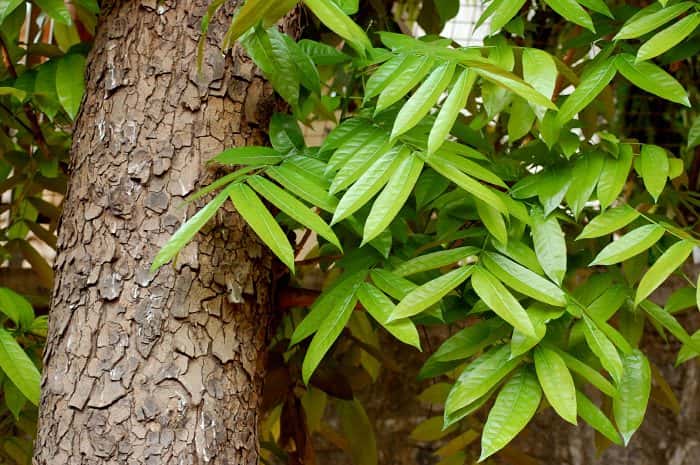
- aLeaves are pinnate, 20–40 cm long, with 3–6 pairs of glossy, dark green, pointed leaflets that are lopsided at the base.
- bFlowers are small, greenish-white and easy to miss, in loose clusters among the leaves in spring.
- cFruit is a large, upright, woody, egg-shaped capsule, 12–20 cm long, that splits into five parts to release winged seeds.
- dBark is dark grey-brown, becoming scaly and furrowed on older trees.
- eOften confused with the small-leaf mahogany (Swietenia mahagoni), which has smaller leaflets, smaller fruit and a lower crown.
02
Mahogany in your city
How it grows in each city we work in, and what we do differently there.
It grows in Pune with irrigation through the long dry season from November to May. We plant it in deep soil and avoid shallow murum over rock.
Frost in December and January damages young trees and 45°C dry heat stresses them. We plant only in sheltered, irrigated spots and generally suggest native trees for open sites in Delhi.
Indore's hot, dry summer and cold nights slow it. We use it only where irrigation is assured and improve black cotton soil pits with murum and compost.
Regular winter frost in Chandigarh damages it year after year. We suggest Shisham, Arjun or other hardy natives instead.
Mumbai's warm, humid climate suits it. We plant on well-drained ground and thin the crown before the monsoon, since the dense crown catches wind.
Bangalore's mild climate suits it and it gives dense shade on campuses. It needs watering in the dry months for the first few years.
The hot, dry Deccan summer is hard on young trees. We plant it with drip irrigation and mulch, and water deeply through March to May.
Ahmedabad's 45°C heat and dry winters stress it. We use it only in irrigated campuses and prefer native species for green belts here.
Mehogoni grows well in Kolkata's humid heat and is planted along many roads. We raise the planting bed in flood-prone ground.
03
Mahogany for industrial green belts
Where it goes in a three-row belt
Boundary side ← → factory side. This plant: outer tall row.
Mahogany suits green belts in frost-free, humid parts of India, where it grows into a tall, dense, nearly evergreen crown that screens dust and gives heavy shade. It is less suited to the dry north-west and to sites with winter frost, where hardy native trees do better.
Where we use it, we place it in the outer tall row, spaced for its wide crown, and mix it with native species. Because it is not native to India, we keep it as one part of the mix and do not build a belt around it alone.
The species mix, belt width and planting density that apply to your unit are the ones written into its own consent to establish or environmental clearance. Clearances commonly ask for about 2,500 trees per hectare, and we plan the rows to meet the numbers in your document.
04
Where it fits
- Avenues and internal roads in campuses in warm, humid cities.
- The outer tall row of a green belt in frost-free regions with good rainfall or irrigation.
- Large shade trees for parking areas set well back from buildings.
- Mixed timber and shade planting on farms in south and east India.
05
Care
- Plant in deep, well-drained soil and water regularly through the first three dry seasons.
- Train young trees to a single straight leader; shoot borer damage often causes forked trunks.
- Thin the crown before the monsoon in windy and coastal sites.
- Keep it 8–10 m from buildings because of its size and spreading roots.
- Mulch the root zone and feed with compost once a year while young.
06
Common problems
- Shoot borer — the tip of the main shoot wilts and dies, and the tree forks. Cut out damaged shoots and train a new leader; keep young trees growing well, as healthy trees outgrow the damage.
- Frost damage — leaves and young shoots turn brown and die after cold nights. Protect young trees in north India, or choose a hardier species.
- Scale insects — crusts on young stems with sooty mould on the leaves. Spray neem oil or horticultural oil.
- Leaf spot — brown spots on leaves in humid weather. Usually minor; remove fallen leaves.
07
Questions
Is mahogany native to India?
No. Big-leaf mahogany comes from Central and South America. It has been planted in India for a long time, mostly in the south, east and on the west coast.
Can mahogany grow in north India?
It struggles where there is regular winter frost, such as around Delhi and Chandigarh. In sheltered, irrigated gardens it can survive, but native trees are a better choice for open sites.
How long does a mahogany tree take to grow?
It grows moderately fast in warm, humid regions with good water, and gives useful shade in 6–8 years. Timber takes much longer.
Does mahogany shed its leaves?
It changes its leaves briefly in the dry season, usually late winter or spring, and new leaves follow within a few weeks.
Also used for avenue & campus
Begin with a visit
Request a proposal
Tell us about the space, or send photos on WhatsApp. We send a written proposal with a fixed price.
hi@gardenandacre.com