Plant library · Green belt · Avenue & campus
Mast Ashoka (Polyalthia)
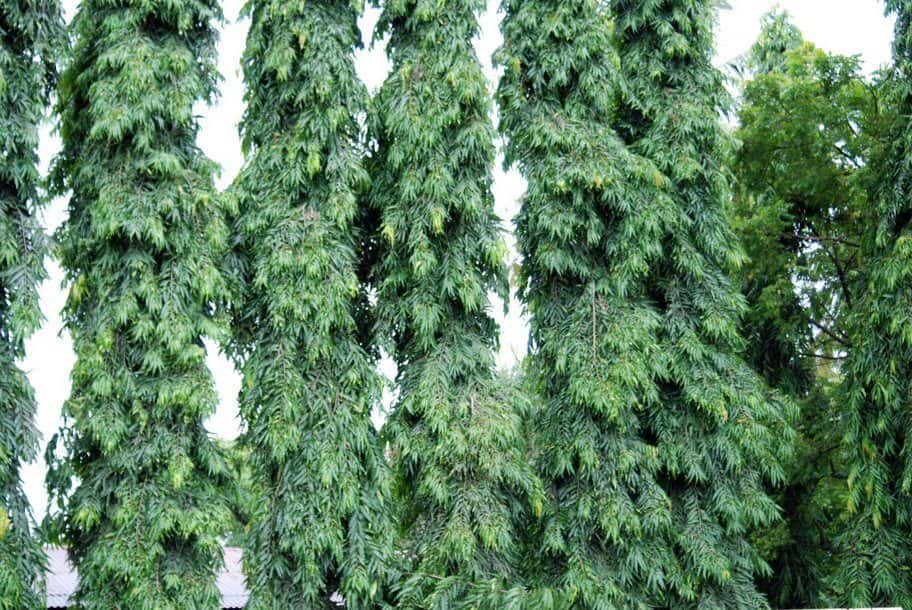
Mast Ashoka is the tall, narrow evergreen tree with drooping, wavy leaves that lines compound walls and roads across India. It is native to India and Sri Lanka. Its column shape lets you plant it close together to form a screen against dust, noise and views without taking much ground, which is why it is so common along boundaries.
Monoon longifolium (syn. Polyalthia longifolia) · Ashok · Nakli Ashok · Devdaru · Asopalav · Debdaru · Nettilingam · Naramamidi · False Ashoka · Indian mast tree
Size
10–15 m tall, 2–4 m spread (pendula form)
Growth
Moderate
Leaf
Evergreen
Sun
Full sun to partial shade.
Water
Regular watering for the first two to three years; established trees need watering only in long dry spells.
Soil
Most well-drained soils; it tolerates moderately alkaline ground.
01
How to recognise Mast Ashoka
Family Annonaceae
- aLeaves are simple, long and narrow (15–25 cm), glossy dark green, with distinctly wavy edges, hanging down from the branches.
- bHabit is a narrow column or cone with branches drooping close to the trunk; the common 'pendula' form looks like a tall green pillar.
- cFlowers are small, pale green and star-shaped, in March and April, and easy to miss among the leaves.
- dFruit is a small oval berry in clusters, green turning purple-black, eaten by birds and bats.
- eOften confused with Sita Ashok (Saraca asoca), which is a smaller spreading tree with leaves divided into leaflets and bright orange-red flower clusters. Mast Ashoka has undivided leaves and no showy flowers.
02
Mast Ashoka (Polyalthia) in your city
How it grows in each city we work in, and what we do differently there.
It is widely planted in Pune and grows steadily with watering in the dry months. We use it on compound boundaries where a narrow screen is needed.
It is one of the most common screening trees in Delhi and handles the summer heat. Young plants can be scorched by frost in December and January, so we plant after the monsoon and cover them on cold nights.
It takes Indore's summer heat well. On black cotton soil we improve the pit with murum and compost so the roots are not waterlogged in the monsoon.
Frost in December and January browns young plants. We plant larger saplings and protect them for the first two winters; established trees handle the cold.
It grows well in Mumbai's humidity and its narrow shape stands up to monsoon wind. We plant on well-drained ground and use it to screen boundaries on tight plots.
Bangalore's mild climate suits it and it keeps a dense, dark green column. We use it along campus boundaries and to screen service areas.
It handles the hot, dry Deccan summer with deep watering in the first few years. We mulch the root zone to keep moisture through April and May.
Asopalav is a familiar tree in Gujarat and copes with Ahmedabad's 45°C heat once established. Saplings need weekly deep watering through the first two summers.
Debdaru grows well in Kolkata's humid climate. We raise the planting line where the ground floods in the monsoon.
03
Mast Ashoka (Polyalthia) for industrial green belts
Where it goes in a three-row belt
Boundary side ← → factory side. This plant: outer tall row.
Mast Ashoka is commonly used in green-belt plans because it is evergreen, holds its leaves close to the ground, and grows into a tall, narrow column. Planted in a line, it forms a year-round screen that catches dust and softens noise from the boundary side, while using less ground width than spreading trees.
We place it in the outer tall row along the compound wall, often alternating with broader native trees so the belt does not rely on one species. Its narrow shape means it does not push against the wall or overhang the neighbour's land as spreading trees can.
The species mix, belt width and planting density that apply to your unit are the ones written into its own consent to establish or environmental clearance. Clearances commonly ask for about 2,500 trees per hectare, and we lay out the rows to meet what your document specifies.
04
Where it fits
- The outer tall row of an industrial green belt along the compound wall.
- Screens along society and campus boundaries where ground width is limited.
- Formal lines along driveways and entrance roads.
- Noise and dust screening between a site and a busy road.
05
Care
- For a screen, plant the pendula form 1.5–3 m apart in a line; for a green belt follow the spacing in your approved plan.
- Water regularly for the first two to three years, deeply and less often, and keep a mulch ring around each tree.
- Remove only dead or damaged branches; the natural column shape needs little pruning.
- Feed with compost once a year for the first few years.
- Check nursery labels: plants sold as 'Ashoka' may be either this tree or Sita Ashok.
06
Common problems
- Leaf-eating caterpillars — chewed or skeletonised leaves, often larvae of the tailed jay butterfly. Mature trees tolerate this; on young plants we hand-pick or use a Bt spray.
- Leaf spot — brown or black spots on older leaves in humid weather. Remove fallen leaves and improve air movement; spray a copper fungicide only if young trees are badly affected.
- Scale and mealybugs — white or brown crusts on stems with sooty mould on the leaves. Spray neem oil or horticultural oil.
- Frost scorch — leaves turn brown after cold nights in north India. Cut back damaged tips in spring once new growth starts.
07
Questions
Is Mast Ashoka the same as the Ashoka tree?
No. The Ashoka of tradition is Sita Ashok (Saraca asoca), a small tree with orange-red flowers. Mast Ashoka (Polyalthia) is an unrelated tall tree with wavy leaves, often sold simply as 'Ashoka'.
How far apart should I plant Mast Ashoka for a screen?
For the narrow pendula form, about 1.5–3 m apart gives a closed screen in a few years. Wider spacing gives a line of separate columns.
Do Mast Ashoka roots damage walls?
Its roots are less aggressive than those of spreading trees, which is why it is planted close to boundaries. Still keep it at least 1–1.5 m from a wall so the trunk has room as it thickens.
Is Mast Ashoka good for a green belt?
Yes, it is commonly used in green-belt plans for the outer row. Mix it with native broadleaf trees so the belt is not a single species.
Also used for green belt
Guides that mention Mast Ashoka (Polyalthia)
Begin with a visit
Request a proposal
Tell us about the space, or send photos on WhatsApp. We send a written proposal with a fixed price.
hi@gardenandacre.com