Plant library · Green belt · Avenue & campus · Miyawaki forest
Pongamia (Karanj)
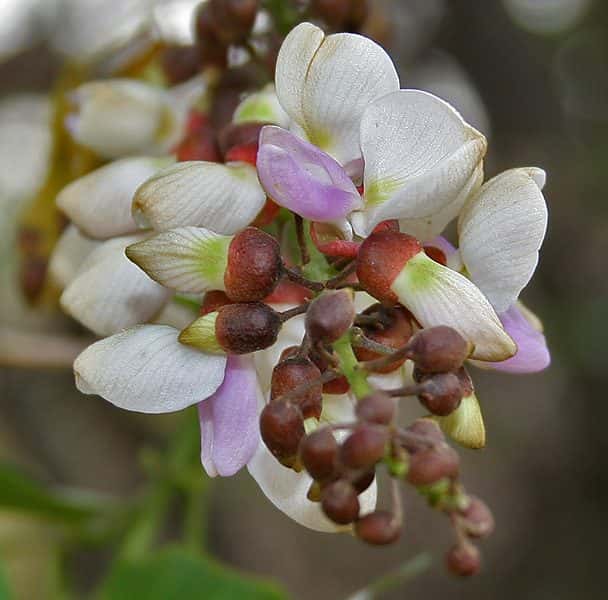
Pongamia, called Karanj in most of India, is a medium-sized native shade tree with glossy leaves and lilac-pink flowers in spring. It takes drought, saline and alkaline soil, coastal winds and short spells of waterlogging. It is one of the most widely planted avenue and green-belt trees in the country.
Millettia pinnata (syn. Pongamia pinnata) · Karanj · Karanja · Pungai · Kanuga · Honge
Size
8–15 m tall, 8–12 m spread
Growth
Fast
Leaf
Semi-evergreen
Sun
Full sun to light shade
Water
Low to moderate; tolerates drought and brief waterlogging
Soil
Almost any soil, including saline, alkaline, sandy and black cotton soil
01
How to recognise Pongamia
Family Fabaceae
- aLeaves are pinnate, with 5–7 glossy, oval leaflets; new leaves in spring are bright, shiny green.
- bFlowers are small, pea-shaped, white to pinkish-lilac, in hanging clusters, usually from about April to June.
- cPods are flat, woody and oval, 4–6 cm long, each holding one or two seeds, turning brown as they ripen.
- dCrown is low, broad and dense; the tree often branches low unless pruned.
- eBark is smooth and grey-brown, becoming slightly rough with age.
02
Pongamia (Karanj) in your city
How it grows in each city we work in, and what we do differently there.
Karanj is one of the most reliable trees for Pune's murrum and shallow soils. We use it widely along society roads and boundaries.
Pongamia handles Delhi's summer heat well. Young plants can be scorched by frost in January, so we plant in the monsoon and shelter saplings in the first winter.
Karanj grows well on Indore's black cotton and stony soils and tolerates the dry season once established.
Mature trees tolerate Chandigarh's light frost, but young plants lose leaves and shoot tips in December–January. We protect saplings for two winters.
Pongamia tolerates Mumbai's salt air, heavy monsoon and brief waterlogging, which makes it one of the better choices near the coast.
Honge is a familiar avenue tree in Bangalore and grows easily in its mild climate and red soils.
Pongamia is well suited to the hot, dry Deccan around Hyderabad. It needs water only through the first two summers.
Karanj handles Ahmedabad's heat, dry winds and saline patches well. We water young trees through April–June.
Pongamia grows well in Kolkata and tolerates monsoon waterlogging better than many shade trees.
03
Pongamia (Karanj) for industrial green belts
Where it goes in a three-row belt
Boundary side ← → factory side. This plant: middle row.
Pongamia is native, fast-growing and hardy, and it grows on saline, alkaline and degraded soils where many trees fail. It is a legume and fixes nitrogen, which helps on poor ground. Its dense, glossy canopy stays in leaf for most of the year, with only a short leaf change in spring. It is commonly used in green-belt plans across India.
We place pongamia in the middle row, below the tallest trees and above the inner low planting, where its broad crown fills gaps quickly. On narrower belts it can take the outer row too. It needs water only in the first couple of dry seasons, so it keeps upkeep low.
The species mix, belt width and planting density that apply are the ones written into the unit's own consent to establish or environmental clearance. Clearances commonly ask for about 2,500 trees per hectare, and we plan the rows to match whatever the document says.
04
Where it fits
- Middle row of an industrial green belt, including on saline or poor soil.
- Avenue tree on society and campus roads.
- Shade tree for parking, with a low, broad crown.
- Coastal and saline sites where many other trees struggle.
- Mid-layer species in a Miyawaki forest.
05
Care
- Water weekly in dry months for the first two years.
- Prune young trees to a single clear trunk of about 2 m for avenues and parking.
- Mulch the basin on dry, sandy or saline sites.
- Sweep fallen pods and leaves from paved areas in spring.
- On saline or alkaline ground, add compost to the pit at planting to help young roots establish.
06
Common problems
- Leaf galls — small raised bumps or finger-like growths on leaves, caused by mites or tiny insects. They are very common, rarely harm the tree, and can be left alone or pruned from young plants.
- Leaf miners and caterpillars — pale trails or chewed patches on new leaves in spring. Mature trees recover; treat young trees only if damage is heavy.
- Low, spreading branches — the tree branches close to the ground if left alone. Lift the lower branches in the first three years.
07
Questions
How fast does karanj grow?
Pongamia is fast-growing, and with some watering young trees can add about a metre a year. It gives useful shade in four to five years.
Can pongamia grow in saline or coastal soil?
Yes. Pongamia tolerates saline and alkaline soils and coastal salt air, which is why it is common near the sea and on degraded land.
How far from a building should karanj be planted?
Keep it about 4–5 m from buildings. It is a medium-sized tree and its roots are less aggressive than those of fig trees.
Is pongamia used in industrial green belts?
Yes. It is commonly used in green-belt plans for its hardiness, fast growth and tolerance of poor soil, usually in the middle row.
Also used for green belt
Guides that mention Pongamia (Karanj)
Begin with a visit
Request a proposal
Tell us about the space, or send photos on WhatsApp. We send a written proposal with a fixed price.
hi@gardenandacre.com