Plant library · Green belt · Miyawaki forest · Avenue & campus
Semal (Red silk cotton)
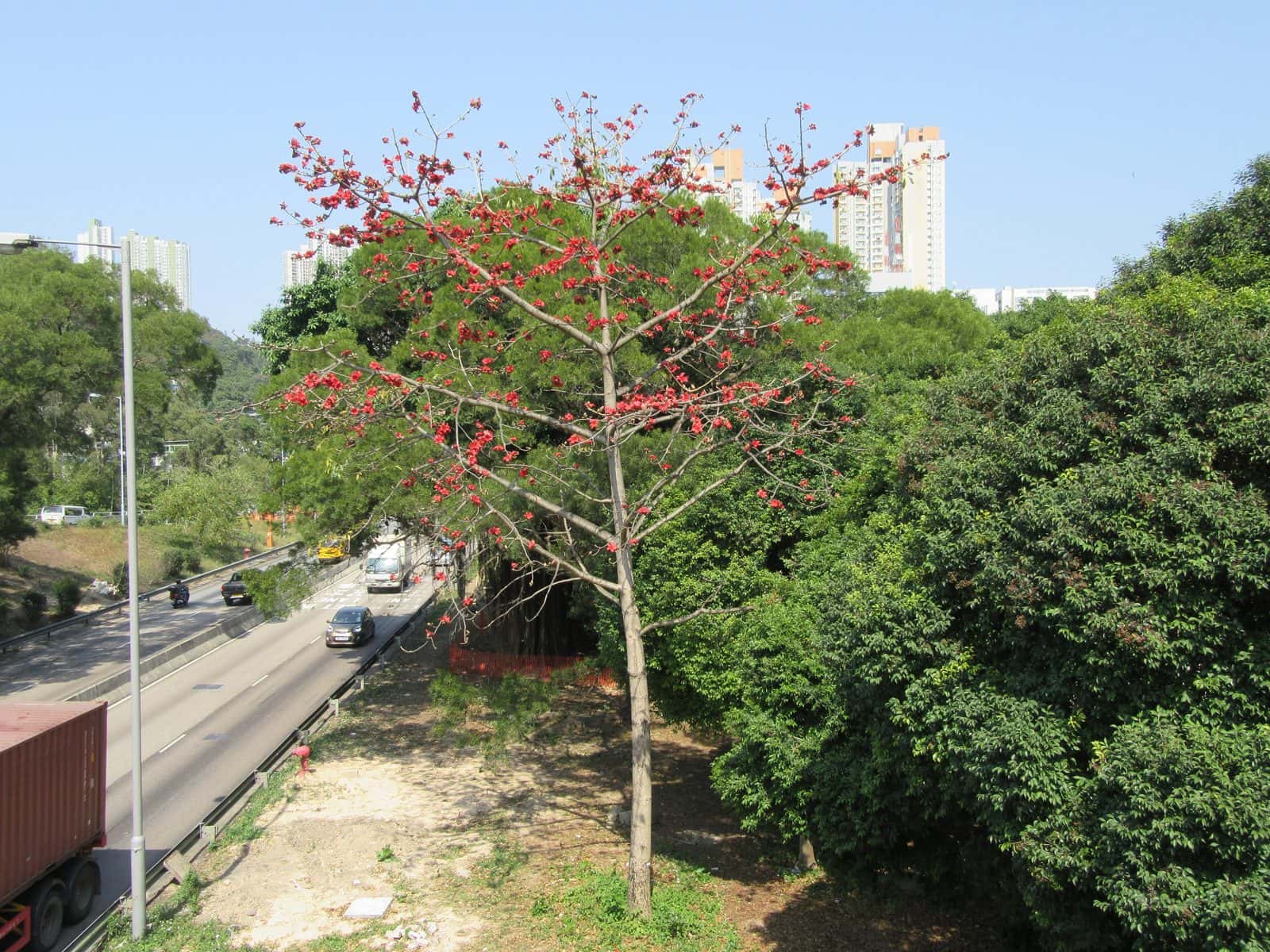
Semal is a tall, fast-growing native tree that carries large red flowers on bare branches from about January to March, followed by pods full of silky cotton-like floss. It is deciduous, hardy across most of India and grows straight with tiers of horizontal branches. We use it in the outer tall row of green belts and as a canopy species in Miyawaki forests, and on wide roads where there is room for its size.
Bombax ceiba · Semal · Semul · Shimul (Bengali) · Sawar (Marathi) · Ilavam (Tamil) · Buruga (Telugu) · Red silk cotton tree
Size
20–30 m tall, 10–15 m spread
Growth
Fast
Leaf
Deciduous
Sun
Full sun
Water
Regular watering for the first two years, then rainfed in most regions
Soil
Deep, well-drained loam or alluvial soil is best; tolerates poorer soils but not prolonged waterlogging
01
How to recognise Semal
Family Malvaceae
- aTrunk is straight and grey, often with sharp conical prickles on young trees and buttresses at the base of old ones.
- bBranches grow out in horizontal whorls, giving a tiered outline.
- cLeaves are palmately compound, with five to seven leaflets spreading from one point like fingers.
- dFlowers are large, thick-petalled and cup-shaped, usually deep red, sometimes orange, and appear on leafless branches in late winter.
- eFruit is an oblong woody capsule that splits in April–May to release seeds wrapped in white floss.
- fOften confused with palash (Butea monosperma), which also flowers red on bare branches but has three-leaflet leaves and curved, beak-like flowers.
02
Semal (Red silk cotton) in your city
How it grows in each city we work in, and what we do differently there.
Common in the Pune region and suited to its climate. Give it room: it is a very large tree within 15–20 years.
Semal is a familiar spring-flowering tree across Delhi. Established trees take the frost and the 45°C summer; young saplings need watering through May–June.
Grows well in the region. On shallow stony ground we dig deeper pits and backfill with soil and compost so the taproot can go down.
Grows in the Chandigarh region and handles the cold once established. Protect saplings in their first winter where frost settles.
Grows in Mumbai's climate. Place it on well-drained ground and away from buildings and paving, since the floss and fallen flowers make a mess.
Grows well in the mild climate. Best on large campuses and open grounds where its height and spread fit.
Handles the hot, dry Deccan summer once established. Deep-water saplings every week or two through the dry months for the first two years.
Grows, but young trees need dependable irrigation through the 45°C summer. Mulch well and water deeply rather than often.
Shimul is a familiar tree in Bengal. Avoid low spots where rainwater stands for days during the monsoon.
03
Semal (Red silk cotton) for industrial green belts
Where it goes in a three-row belt
Boundary side ← → factory side. This plant: outer tall row.
Semal is native, fast-growing and hardy, and it is commonly used in green-belt plans to build height quickly along a boundary. Its tall, straight trunk and tiered crown give a high screen, and its spring flowers attract birds.
We place it in the outer tall row, spaced wide enough for its spread, and mix it with evergreen tall species because semal is leafless for part of the dry season. We keep it back from boundary walls, drains and power lines, and away from air intakes and cooling towers, since the floss released in April–May can clog filters.
The species mix, belt width and planting density that apply to a site are the ones set out in the unit's own consent to establish, consent to operate or environmental clearance.
04
Where it fits
- Outer tall row of an industrial green belt, for height and fast cover.
- Canopy layer of a Miyawaki forest, alongside other tall native species.
- Avenues on wide roads with generous setbacks from buildings and underground services.
- Large campuses, farm boundaries and open grounds where a big flowering tree is wanted.
05
Care
- Water saplings weekly in the first dry season and fortnightly in the second; established trees in most cities manage on rainfall.
- Keep a single straight leader when young; remove competing shoots early rather than cutting large limbs later.
- Mulch the base to hold moisture and keep weeds down in the first two years.
- Plan for clean-up of fallen flowers in February–March and floss in April–May near paths, pools and parking.
06
Common problems
- Floss nuisance — white fibre drifting in April–May and blocking filters and gutters; place the tree away from air intakes, pools and gutters, and sweep during pod season.
- Stem borers — holes and frass on the trunk of young trees; clean and treat the tunnels and keep saplings well watered to reduce stress.
- Frost damage on saplings — blackened shoot tips after cold nights in the north; cover young plants in their first winter and cut back dead tips in spring.
- Slippery paving — fallen fleshy flowers on roads and paths; avoid planting directly over walkways and sweep regularly in the flowering season.
07
Questions
When does semal flower?
Usually from about January to March, on bare branches. Pods open in April–May and release the floss.
Is semal suitable for a housing society?
Only where there is plenty of open space. It becomes a very large tree, and the floss and fallen flowers need regular clean-up near buildings and parking.
How fast does semal grow?
It is one of the faster native trees. With water in the early years it gains height quickly, though the exact rate depends on soil and site.
Are the prickles on the trunk a problem?
Young trees carry sharp conical prickles, so avoid planting it where children climb or brush past. Older trunks usually lose many of them.
Also used for green belt
Guides that mention Semal (Red silk cotton)
Begin with a visit
Request a proposal
Tell us about the space, or send photos on WhatsApp. We send a written proposal with a fixed price.
hi@gardenandacre.com