Plant library · Green belt · Avenue & campus
Siris
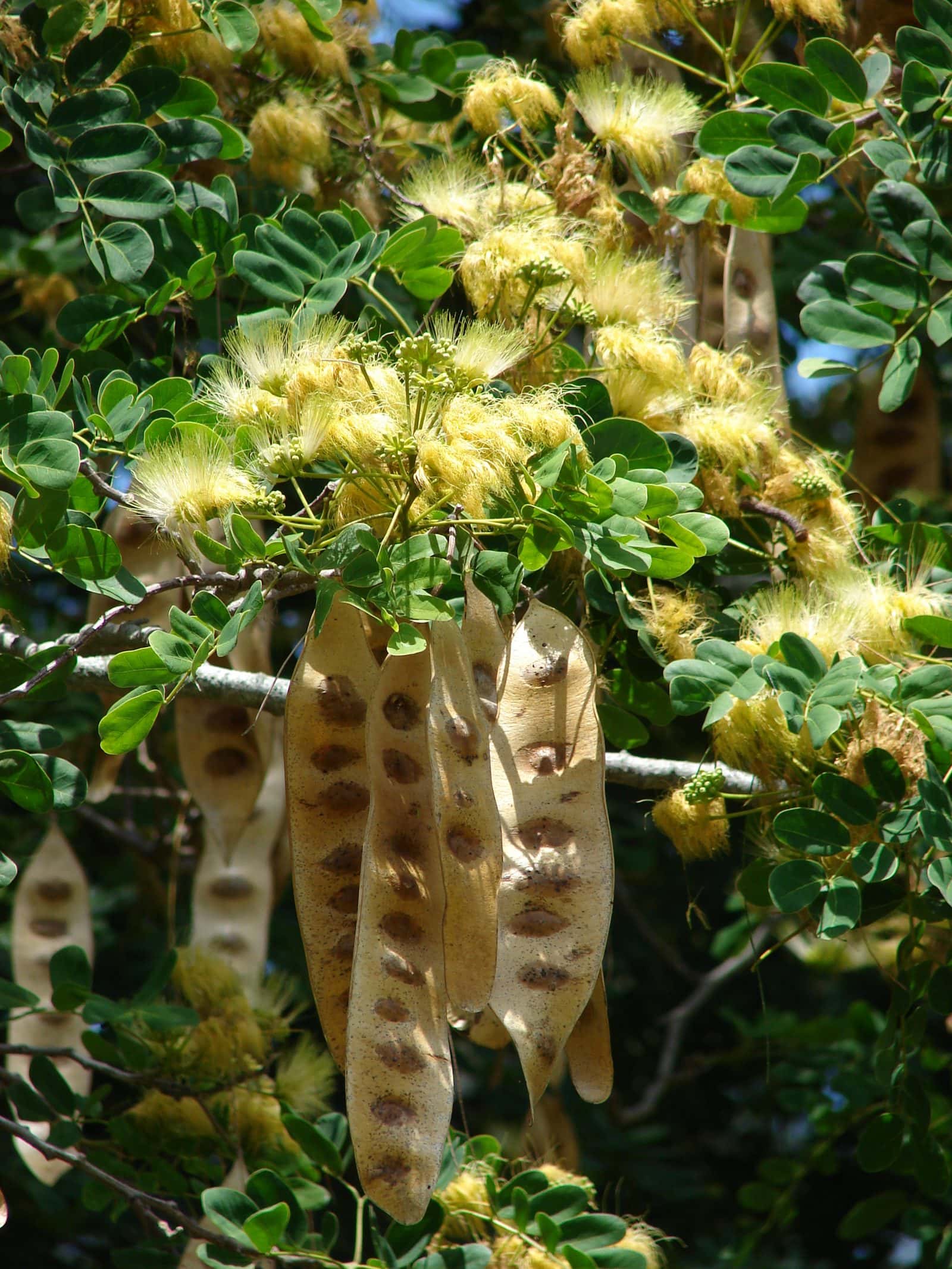
Siris is a native shade tree with feathery leaves, fragrant powder-puff flowers in spring and long, papery pods that rattle in the wind. It is drought-hardy, fixes nitrogen and grows on poor soil. It is widely used along roads and in green belts in drier parts of India.
Albizia lebbeck · Shirish · Sirish · Vaagai · Dirisena · Bage
Size
12–20 m tall, 10–15 m spread
Growth
Fast
Leaf
Deciduous
Sun
Full sun
Water
Low once established
Soil
Most soils, including sandy, stony, black cotton and mildly saline soil; needs drainage
01
How to recognise Siris
Family Fabaceae
- aLeaves are twice-divided, with 2–4 pairs of side stalks, each carrying several pairs of oblong leaflets 2–4 cm long.
- bFlowers are fluffy powder-puff heads of long, greenish-white to cream stamens, strongly fragrant, usually from about March to May.
- cPods are flat, straw-coloured and papery, 15–30 cm long, hanging in bunches and rattling in wind; many stay on the tree through winter.
- dBark is grey-brown and rough; the crown is broad and umbrella-shaped.
- eOften confused with the rain tree (Samanea saman), which has pink-tipped flowers and dark, fleshy pods, and with other Albizia species.
02
Siris in your city
How it grows in each city we work in, and what we do differently there.
Siris grows well on Pune's shallow, stony soils and handles the dry season once established.
Siris is a common roadside tree in Delhi and handles both the 45°C summers and light winter frost once established. We shelter saplings in their first winter.
Siris suits Indore's black cotton and stony soils. We add murrum to pits on heavy black soil to keep drainage open.
Siris tolerates Chandigarh's winter better than most tropical shade trees. It loses its leaves in the cold months and leafs out again in spring.
Siris grows in Mumbai, but its brittle branches can break in monsoon storms and it dislikes waterlogged corners. We plant it on well-drained spots away from buildings.
Siris grows easily in Bangalore's mild climate and red soils.
Siris is well suited to the hot, dry Deccan and needs water only through its first two summers.
Siris handles Ahmedabad's heat and dry winds well. We water young trees through April–June.
Siris grows in Kolkata but dislikes heavy, waterlogged clay. We choose higher, well-drained spots.
03
Siris for industrial green belts
Where it goes in a three-row belt
Boundary side ← → factory side. This plant: middle row.
Siris is native, fast-growing and drought-hardy, and as a legume it fixes nitrogen and improves poor soil. Its broad crown gives good shade for most of the year, though it drops its leaves for a spell in the dry season. It is commonly used in green-belt plans in drier regions.
Because it is deciduous, we place siris in the middle row, mixed with evergreen trees such as neem, jamun and pongamia so the belt keeps cover through the year. It needs water only in the first couple of dry seasons.
The species mix, belt width and planting density that apply are the ones written into the unit's own consent to establish or environmental clearance. Clearances commonly ask for about 2,500 trees per hectare, and we plan the rows to match whatever the document says.
04
Where it fits
- Middle row of an industrial green belt on dry or poor soil.
- Avenue tree on wide roads with space for its broad crown.
- Shade tree for open grounds on campuses and farms.
- Nitrogen-fixing tree for farm boundaries and degraded land.
05
Care
- Water weekly in dry months for the first two years.
- Prune young trees to a single strong leader, removing narrow forks that split later.
- Remove dead and weak branches before the monsoon to reduce storm breakage.
- Keep it away from parking and buildings because of brittle branches and pod fall.
- Expect heavy leaf and pod fall in the dry season, and plan sweeping on paved areas around it.
06
Common problems
- Bark-eating caterpillars — frass-covered webbing on the bark and holes in the trunk or branches. Clear the webbing, clean out the holes and treat them early.
- Leaf-eating caterpillars — defoliated shoots in the monsoon. Mature trees recover; treat young trees only if they are stripped.
- Branch breakage — split limbs after storms. Prune narrow forks when young and remove weak branches before the monsoon.
- Heart rot — soft, hollow wood in older trunks, often behind old wounds. Make clean pruning cuts and have large old trees checked for safety.
07
Questions
Is siris evergreen?
No. Siris is deciduous and sheds its leaves for a period in the dry season, usually in late winter or spring, before new leaves and flowers come.
How fast does siris grow?
Siris is fast-growing, and young trees with some water can add over a metre a year.
How far from a house should siris be planted?
Keep siris about 6–8 m from buildings, parking and roofs, because its branches can break in storms.
Is siris good for a green belt?
Yes. It is drought-hardy, fixes nitrogen and is commonly used in green-belt plans. Because it is deciduous, we mix it with evergreen trees.
Also used for green belt
Guides that mention Siris
Begin with a visit
Request a proposal
Tell us about the space, or send photos on WhatsApp. We send a written proposal with a fixed price.
hi@gardenandacre.com