Plant library · Green belt · Miyawaki forest
Bael
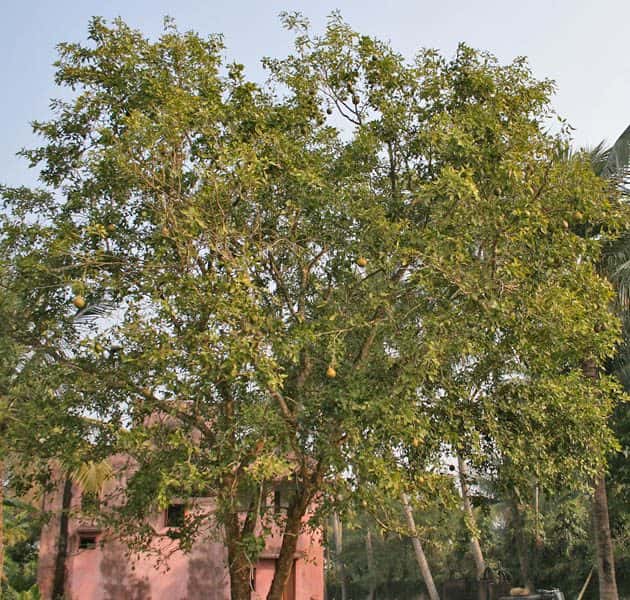
Bael is a hardy, thorny native tree with aromatic three-part leaves and a hard-shelled round fruit that takes nearly a year to ripen. It tolerates heat, drought and poor, alkaline soils, and holds its place in both farm orchards and green belts. Its leaves are offered in Shiva worship, and the tree is commonly planted near temples and homes. The fruit pulp is used in drinks and preserves, and in Ayurveda. In a Miyawaki forest it belongs in the tree layer.
Aegle marmelos · Bel · Bael · Bilva (Sanskrit) · Vilvam (Tamil) · Maredu (Telugu) · Bilpatre (Kannada) · Wood apple · Stone apple
Size
6–12 m tall, 5–8 m spread
Growth
Slow
Leaf
Deciduous
Sun
Full sun
Water
Regular watering for the first two years; drought tolerant once established
Soil
Most well-drained soils, including alkaline, stony and poor soils; avoid waterlogged ground
01
How to recognise Bael
Family Rutaceae
- aLeaves are trifoliate, with three leaflets, the middle one larger, and smell aromatic when crushed.
- bBranches carry straight, sharp thorns, usually in pairs or singly at the leaf bases.
- cFlowers are greenish-white, sweetly scented and appear in small clusters around April–May with the new leaves.
- dFruit is round to oval, 8–15 cm or more across, with a hard woody shell that turns from grey-green to yellowish when ripe, usually in spring of the following year.
- eThe tree sheds its leaves for a short time in the hot dry season before new growth.
- fOften confused with wood apple or kaith (Limonia acidissima), which also has a hard round fruit but has pinnate leaves with five to seven small leaflets.
02
Bael in your city
How it grows in each city we work in, and what we do differently there.
Suits the Pune climate and is common in the region. Grafted plants fruit earlier than seedlings.
Bael handles Delhi's 45°C summers and cold winters well once established. Young plants need watering in the first two summers and some frost cover in their first winter.
Well suited to the Malwa region. On black cotton soil we improve drainage in the pit so roots do not stay wet in the monsoon.
Grows well across the north Indian plains. Protect saplings from frost for the first winter or two.
Grows, but the long heavy monsoon and humidity are less suited than the drier interior. Plant on well-drained ground away from salt spray.
Grows in the mild Bangalore climate. Good for temple gardens and farmhouse orchards around the city.
Handles the hot, dry Deccan well and is a sound choice for dry sites. Water young plants deeply through the first two summers.
One of the fruit trees that copes with Gujarat's heat and alkaline soils once established. Irrigate for the first two to three summers.
Bael is common in Bengal, but it needs well-drained spots. Plant on mounds where monsoon water collects.
03
Bael for industrial green belts
Where it goes in a three-row belt
Boundary side ← → factory side. This plant: middle row.
Bael is native, tolerates heat, drought and alkaline soils, and is commonly used in green-belt plans alongside other hardy native trees. Its dense, thorny branches add a barrier effect and it keeps a moderate height.
We place it in the middle row, between tall outer trees and the inner shrub row. The heavy fruit can fall and cause damage, so we keep bael away from footpaths, parking and vehicle routes, and we pair it with evergreen species because it is briefly leafless in the dry season.
The species mix, belt width and planting density that apply to a site are the ones set out in the unit's own consent to establish, consent to operate or environmental clearance.
04
Where it fits
- Middle row of a green belt on dry or alkaline sites.
- Tree layer of a Miyawaki forest, beneath the tall canopy species.
- Temple gardens and courtyards where the tree has cultural significance.
- Farm orchards and farm boundaries, where its thorns also discourage entry.
05
Care
- Water weekly in the first summer and fortnightly in the second; after that, only in long dry spells.
- Prefer grafted plants for fruit; seedling trees can take many years to bear.
- Prune in the early years to form a single trunk and open crown; wear gloves because of the thorns.
- Apply compost or manure around the drip line before the monsoon.
- Collect ripe fruit before it falls where the tree stands near paths or seating.
06
Common problems
- Lemon butterfly caterpillars — leaves eaten back on young plants; hand-pick caterpillars and eggs on small trees.
- Fruit cracking — splits in the shell before ripening, often after uneven watering; keep moisture steady during fruit development.
- Bark borers — frass and holes on the trunk; clean the tunnels and treat them, and keep trees vigorous.
- Leaf spot and canker — dark spots on leaves and shoots in wet weather; remove affected parts and improve air flow by thinning the crown.
07
Questions
How long does a bael tree take to fruit?
Grafted plants usually begin bearing in about four to six years. Seedling trees can take considerably longer.
When does bael fruit ripen?
Flowers appear around April–May and the fruit ripens roughly a year later, usually in March–May of the following year.
Is bael the same as wood apple?
The name wood apple is used for both, but they are different trees. Bael has three-part leaves; kaith (Limonia acidissima) has leaves with five to seven small leaflets.
Can bael be planted near a house?
Yes, with some care. Keep it a few metres from walls and away from car parking and paths, since the heavy fruit falls when ripe and the branches are thorny.
Begin with a visit
Request a proposal
Tell us about the space, or send photos on WhatsApp. We send a written proposal with a fixed price.
hi@gardenandacre.com