Plant library · Avenue & campus · Terrace
Frangipani (Champa)
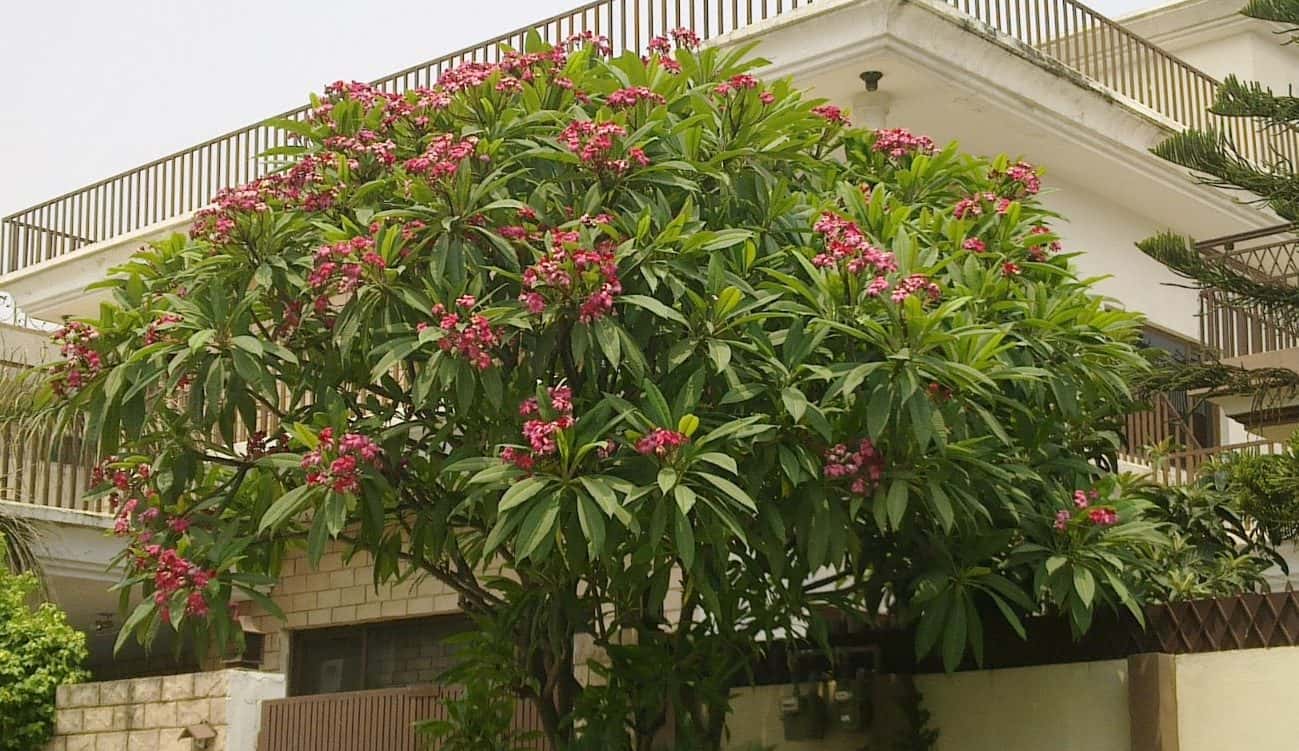
Frangipani, called Champa or Gulachin in Hindi and Chafa in Marathi, is a small tree with thick, blunt branches and fragrant five-petalled flowers. Plumeria rubra, with flowers in white, yellow, pink and red, loses its leaves in the cool or dry season; Plumeria obtusa, the white-flowered type with rounded leaves, stays evergreen in warm cities. It tolerates heat and drought well, and its milky sap can irritate the skin.
Plumeria rubra and P. obtusa · Champa · Gulachin · Khurchafa · Kathgolap · Devaganagalu
Size
3–6 m tall, 3–5 m spread in the ground; 1–2.5 m in large pots
Growth
Moderate
Leaf
Deciduous
Sun
Full sun; at least six hours a day for good flowering
Water
Low to moderate. Water deeply and let the soil dry between waterings; reduce watering sharply when the tree is leafless.
Soil
Well-drained soil of any type, including sandy and rocky soil; waterlogged soil causes stem and root rot
01
How to recognise Frangipani
Family Apocynaceae
- aBranches are thick, succulent and blunt-ended, forking regularly to give an open, umbrella-like crown.
- bLeaves are large, 15–35 cm long, clustered at the branch tips; pointed with prominent veins in P. rubra and shorter, glossy and rounded at the tip in P. obtusa.
- cFlowers are waxy with five overlapping petals in a pinwheel shape, fragrant, in clusters at the branch tips.
- dColours are white with a yellow centre, yellow, pink, red or mixed in P. rubra; pure white with a yellow eye in P. obtusa.
- eSap is milky white and flows from any cut or broken leaf or branch.
- fSeed pods are long, paired and pointed, though many garden plants rarely set them.
02
Frangipani (Champa) in your city
How it grows in each city we work in, and what we do differently there.
Flowers from late spring through the monsoon. Plant on raised or sloping ground where monsoon water drains away.
P. rubra is widely grown in Delhi and drops its leaves in winter. Frost in December and January can damage young tips; protect small plants for the first two winters.
Tolerates the heat, but black cotton soil holds water and can rot the roots. Plant in a large pit backfilled with gravel, sand and compost, or on a raised mound.
Frost in December and January can damage branch tips and young plants. Choose P. rubra over the more cold-sensitive P. obtusa, and plant against a south-facing wall.
Tolerates salt air and grows in coastal gardens. Heavy monsoon rain can cause rot in poorly drained spots, so plant on raised beds.
The mild climate suits it well; P. obtusa stays evergreen here and flowers for much of the year.
Well suited to the hot, dry climate and the rocky soils around the city.
Handles 45°C heat in the ground. In terrace pots, water deeply every two or three days in summer and much less in winter.
Grows well if drainage is good. Watch for rust on the leaves in the humid months.
03
Where it fits
- A small flowering tree along driveways, campus paths and entrance plazas.
- A specimen tree in courtyards, lawns and farmhouse gardens.
- Large containers on terraces and podium gardens, where its drought tolerance helps.
- Temple and heritage-style gardens, where the flowers are used in offerings.
04
Care
- Safety: the milky sap can irritate skin and eyes. Wear gloves when pruning and wash off any sap that touches the skin.
- Pruning: prune only to shape or remove damaged branches, in late winter or early spring before new growth. Each cut makes the branch fork, giving a bushier tree with more flowering tips.
- Feeding: feed in spring and early summer with compost and a fertiliser higher in phosphorus and potash to support flowering.
- Pot size and watering: on terraces use a container at least 50–60 cm wide and deep with a gritty, well-drained mix. Water only when the mix is dry a few centimetres down, and very little when the tree is leafless.
- Terrace wind: large leaves catch the wind and top-heavy plants can tip, so use heavy pots, stake young trees and place them where a parapet gives some shelter.
05
Common problems
- Frangipani rust — orange powdery spots under the leaves and yellow patches on top, most common in humid weather. Remove and dispose of affected leaves and fallen leaves; improve air flow.
- Stem and root rot — soft, black or shrivelled branches and a wobbly trunk base. Caused by waterlogging or overwatering in cool weather; cut back to firm wood, let cuts dry and improve drainage.
- Mealybug and whitefly — white insects on leaves and stems, with sticky honeydew. Spray neem oil or insecticidal soap and repeat weekly.
- Leaf drop — normal in winter or the dry season for P. rubra. Reduce watering and wait for new leaves in spring.
06
Questions
Why is my frangipani not flowering?
Too little sun, young plant age, too much nitrogen or overwatering. Give it full sun, use a phosphorus and potash-rich feed and let the soil dry between waterings.
Is frangipani sap harmful?
The milky sap can irritate skin and eyes. Wear gloves when pruning and wash hands afterwards; keep sap away from the face.
Why does my frangipani lose its leaves in winter?
Plumeria rubra is naturally deciduous in the cool or dry season. The leaves return in spring, often with the first flowers.
Can frangipani be grown in a pot on a terrace?
Yes, in a large container at least 50–60 cm wide and deep with a well-drained mix. Stake it against wind and water sparingly, especially in winter.
Also used for avenue & campus
Guides that mention Frangipani (Champa)
Begin with a visit
Request a proposal
Tell us about the space, or send photos on WhatsApp. We send a written proposal with a fixed price.
hi@gardenandacre.com