Plant library · Green belt · Avenue & campus · Miyawaki forest
Imli (Tamarind)
Tamarind is a slow-growing, long-lived tree with a dense, rounded crown and sour fruit used across Indian kitchens. It originated in tropical Africa and has been grown in India for so long that it is part of village and roadside landscapes everywhere. It takes heat, drought and poor soil very well, which makes it a dependable tree for dry regions.
Tamarindus indica · Imli · Chinch · Puli · Chintha · Hunase · Tentul · Amli · Tamarind
Size
12–20 m tall, 10–15 m spread
Growth
Slow
Leaf
Evergreen
Sun
Full sun.
Water
Water young plants through the first two or three dry seasons; established trees are very drought tolerant.
Soil
Almost any well-drained soil, including sandy, stony and moderately alkaline ground.
01
How to recognise Imli
Family Fabaceae
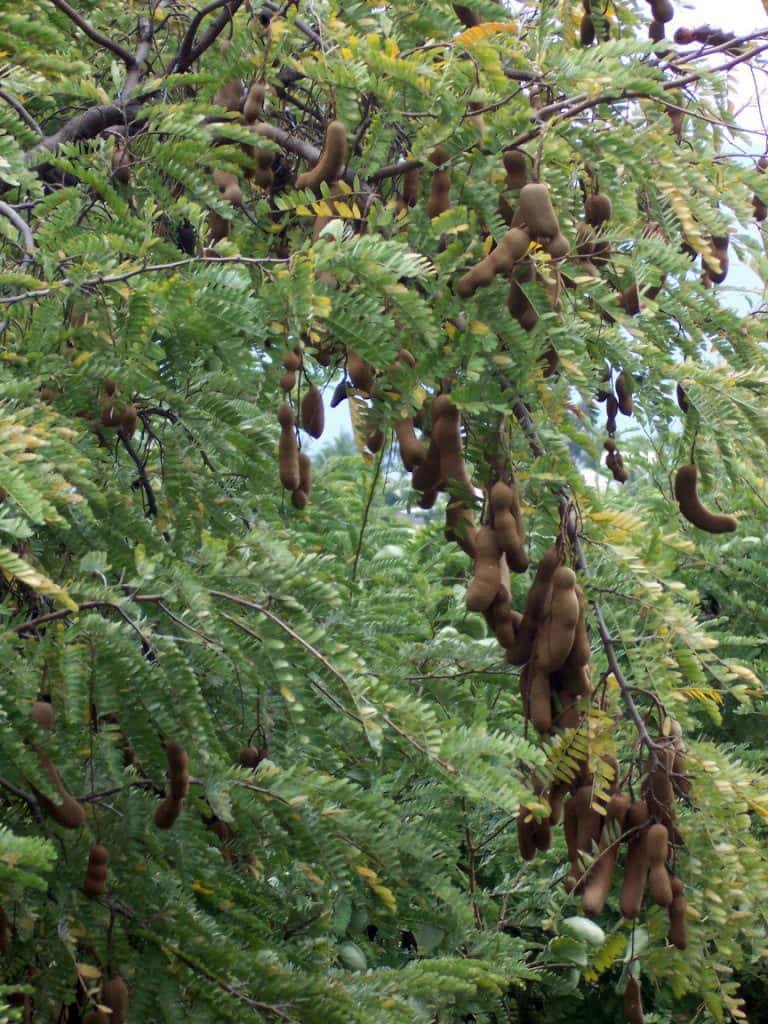
- aLeaves are pinnate, with 10–20 pairs of small, narrow, oblong leaflets that fold up at night.
- bFlowers are small, pale yellow with red or pink veins, in loose clusters, usually in the summer months.
- cFruit is a curved, brown, bean-like pod, 5–15 cm long, with a brittle shell around sticky sour pulp and hard shiny seeds; pods ripen in late winter to spring.
- dBark is dark grey, rough and deeply furrowed, on a thick trunk.
- eHabit is a broad, dense, dome-shaped crown with drooping branch tips; it can be confused with Gulmohar or Rain Tree from a distance, but those have much larger, feathery leaves and lighter crowns.
02
Imli (Tamarind) in your city
How it grows in each city we work in, and what we do differently there.
It grows well on Pune's murum and red soils and fruits well in the dry season. We plant in June and water only through the first two summers.
Established trees handle Delhi's 45°C heat and light frost. Young plants need frost cover in December and January for the first two winters.
It is well suited to Indore's hot summers and stony ground. On black cotton soil we add murum to the pit so roots are not waterlogged in the monsoon.
Winter frost damages young plants and slows growth. We use well-grown saplings, plant in sheltered spots and protect them for the first few winters.
It grows well in Mumbai's warmth if the ground drains. We plant on raised beds in low-lying plots.
Tamarind is a traditional tree across Karnataka and grows well in Bangalore on red soils. It needs little water once established.
The hot, dry Deccan suits it very well and it is common across Telangana. We use it on sites where irrigation after establishment is limited.
It handles Ahmedabad's 45°C heat and dry winters once established. Saplings need weekly deep watering through the first two summers.
Tentul grows well in Kolkata's humid heat. We raise the planting bed where monsoon water stands.
03
Imli (Tamarind) for industrial green belts
Where it goes in a three-row belt
Boundary side ← → factory side. This plant: middle row.
Tamarind is commonly used in green-belt plans in the Deccan and other dry regions because it is very drought tolerant, lives for a long time and forms a dense, evergreen crown that holds dust. It grows on poor, stony and alkaline soils with little care once established.
It grows slowly in its first years, so we place it in the middle row behind a faster outer row that gives early height. Over time its broad crown fills the belt and it stays useful for decades.
The species mix, belt width and planting density that apply to your unit are the ones written into its own consent to establish or environmental clearance. Clearances commonly ask for about 2,500 trees per hectare, and we plan the rows to match what your document specifies.
04
Where it fits
- The middle row of an industrial green belt in dry and semi-arid regions.
- Long-lived shade trees on farm boundaries and farmhouse driveways.
- Village-style avenues on wide roads with enough room for its crown.
- A fruit tree for farmhouses and managed farms where there is space for a large tree.
05
Care
- Plant during the monsoon and water deeply every week or two in the dry season for the first two to three years.
- Use grafted plants if you want fruit sooner and of known quality; seedlings can take many years to bear.
- Prune young trees to a single trunk with well-spaced branches; mature trees need only dead wood removed.
- Keep it well away from buildings and walls because of its size and heavy branches.
- Mulch and weed around young trees, which are slow to establish.
06
Common problems
- Scale insects and mealybugs — white or brown crusts on shoots and pods with sooty mould. Spray neem oil or horticultural oil on young trees; mature trees usually tolerate them.
- Pod and seed borers — holes in pods and damaged pulp. Collect and destroy fallen and infested pods to reduce the next season's attack.
- Termites — mud tunnels on young stems in dry soils. Clear the tunnels and treat the soil around the base.
- Slow establishment — saplings sit still for a year or two after planting. This is normal; keep watering and weeding.
07
Questions
How long does a tamarind tree take to give fruit?
Grafted plants often start bearing in 4–5 years. Trees grown from seed usually take much longer, often 8–10 years or more.
Is tamarind native to India?
It originated in tropical Africa but has been grown in India for many centuries and is now naturalised across the country.
Can I plant a tamarind tree near my house?
Only if you have a lot of space. It becomes a very large, heavy tree, so keep it at least 10 m from buildings and walls.
Is tamarind good for a green belt?
Yes, especially in dry regions. It is drought hardy, long-lived and evergreen. Because it grows slowly at first, we pair it with faster trees in the outer row.
Also used for green belt
Guides that mention Imli (Tamarind)
Begin with a visit
Request a proposal
Tell us about the space, or send photos on WhatsApp. We send a written proposal with a fixed price.
hi@gardenandacre.com